
All cryptocurrencies
Welcome to CoinMarketCap.com! This site was founded in May 2013 by Brandon Chez to provide up-to-date cryptocurrency prices, charts and data about the emerging cryptocurrency markets https://leovegas-au.org/. Since then, the world of blockchain and cryptocurrency has grown exponentially and we are very proud to have grown with it. We take our data very seriously and we do not change our data to fit any narrative: we stand for accurately, timely and unbiased information.
In January 2024 the SEC approved 11 exchange traded funds to invest in Bitcoin. There were already a number of Bitcoin ETFs available in other countries, but this change allowed them to be available to retail investors in the United States. This opens the way for a much wider range of investors to be able to add some exposure to cryptocurrency in their portfolios.
The first chain to launch smart contracts was Ethereum. A smart contract enables multiple scripts to engage with each other using clearly defined rules, to execute on tasks which can become a coded form of a contract. They have revolutionized the digital asset space because they have enabled decentralized exchanges, decentralized finance, ICOs, IDOs and much more. A huge proportion of the value created and stored in cryptocurrency is enabled by smart contracts.
Related Links Are you ready to learn more? Visit our glossary and crypto learning center. Are you interested in the scope of crypto assets? Investigate our list of cryptocurrency categories. Are you interested in knowing which the hottest dex pairs are currently?
Are all cryptocurrencies mined
The new hash outputs are then organized into pairs and hashed again, and the process is repeated until a single hash is created. This last hash is known as the root hash (or Merkle root) and is basically the hash that represents all the previous hashes used to generate it.
With the number of new bitcoins issued per block decreasing by half approximately every four years, the final bitcoin (realistically the final satoshi) is not expected to be generated until 2140 (it might be earlier). The number of new bitcoins minted per block was 50 when Bitcoin was first established and has since decreased to 3.125 as of 2024—the next halving to 1.5625 is expected sometime in 2028.
It’s also worth pointing out that the proof-of-stake model may allow bigger stakeholders to have more say in the direction a network and token heads in the future. For instance, most NEO tokens are held by a few of its founding team members. Though this helps with transaction processing times and network consensus since there are very few stakeholders, it also makes NEO a centralized, rather than decentralized, cryptocurrency. In other words, a few major players could wield a lot of power within the proof-of-stake model, which simply wouldn’t be possible with proof-of-work.
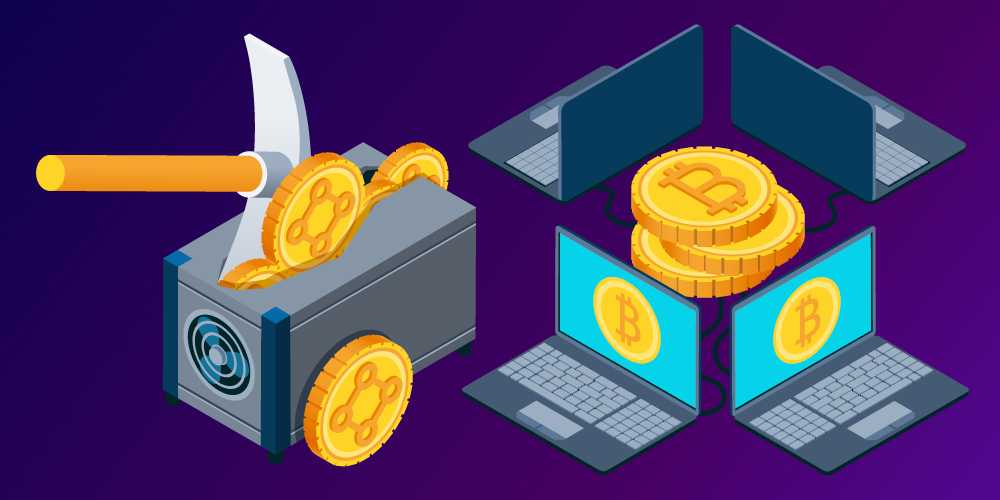
The new hash outputs are then organized into pairs and hashed again, and the process is repeated until a single hash is created. This last hash is known as the root hash (or Merkle root) and is basically the hash that represents all the previous hashes used to generate it.
With the number of new bitcoins issued per block decreasing by half approximately every four years, the final bitcoin (realistically the final satoshi) is not expected to be generated until 2140 (it might be earlier). The number of new bitcoins minted per block was 50 when Bitcoin was first established and has since decreased to 3.125 as of 2024—the next halving to 1.5625 is expected sometime in 2028.
Are all cryptocurrencies based on blockchain
Another advantage of cryptocurrency is that it’s global, eliminating the need to figure out or pay foreign exchange rates. Although cryptocurrency isn’t legal in some countries, you also don’t need to worry about bank account restrictions, such as ATM withdrawal limits.
Cryptocurrencies are fungible, meaning the value remains the same when bought, sold, or traded. Cryptocurrency isn’t the same as non-fungible tokens (NFTs) with variable values. For example, one dollar in crypto will always be one dollar, whereas the value of one NFT dollar depends on the digital asset it’s attached to.
Blockchain technology is a revolutionary digital ledger system that records transactions across a decentralized network of computers, ensuring transparency, security, and immutability. Unlike traditional databases, where a central authority manages data, blockchain operates on a peer-to-peer network, where each participant, or node, holds a copy of the entire ledger. This decentralized nature eliminates the need for intermediaries, reducing the risk of fraud and enhancing trust among users. Each transaction is grouped into a block, linked chronologically to the previous one, forming a chain that is virtually tamper-proof due to cryptographic hashing. Beyond its initial application in powering cryptocurrencies like Bitcoin, blockchain’s potential extends to various sectors, including digital assets, supply chain management, healthcare, and finance, offering innovative solutions for data integrity and operational efficiency.
Yes, each cryptocurrency has its own unique blockchain, which is a decentralized, digital ledger that records transactions and facilitates the exchange of that coin. This allows for independent operation and management of each cryptocurrency.
